
Vibration test, random test, sine test
Barely noticeable, yet simulatable: vibration during transport
.
Vibrations are minimal impacts that affect a product. They naturally accompany any transport, as they are triggered by the moving means of transport. It is common knowledge that these shocks can affect the functionality or quality of products: Bubble formation in liquids or, quite the opposite: lack of carbon dioxide at the destination. Switches and release mechanisms can be damaged, free-hanging device components can even break off.
Surely you can still think of an individual possible damage for your product. For this reason, we test your packaging on our shaker with simulated vibrations, we really shake it: repeatable, accelerated and well documented. The LAB shaker can test up to 1.35 tons vertically, depending on the test program. The UD-Shaker is particularly suitable for environmental simulations: it offers both vertical and horizontal testing.
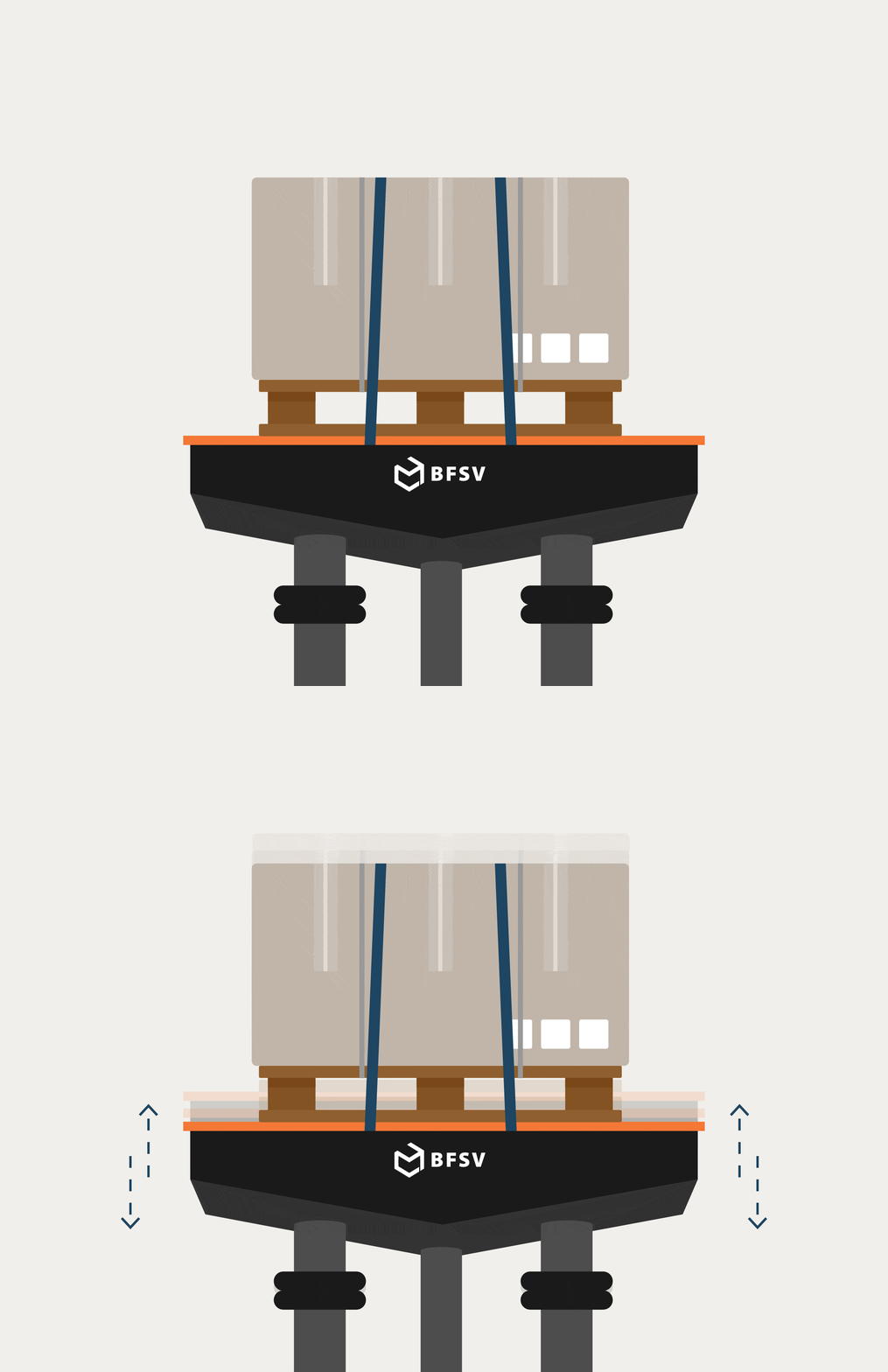
Variety in the test lab: shock, random, sinusoidal testing
We offer our vibration tests in different variants: Shock, Random and Sinusoidal testing. The Random test method means that a noise function tests the sample over a given test intensity and frequency width.
Sine tests map harmonic oscillations and simulate the path from functional product to fatigue failure. If a single point is loaded over and over again, then it will fatigue, and may break. With sinusoidal testing, it is important to know that it does a lot of damage to products and packaging in the resonant range. When excited outside the resonance range, sinusoidal vibrations are many times less dangerous for products and packaging.
Strokes with different intensity - but the identical result
Which of these three test variants meets your requirements? We will advise you comprehensively, because: it is important that there is one result at the end of our test procedures. Namely, that your products, loading units and packaging arrive at their destination free of defects. And that even and despite the fact that they have been jolted along the way.
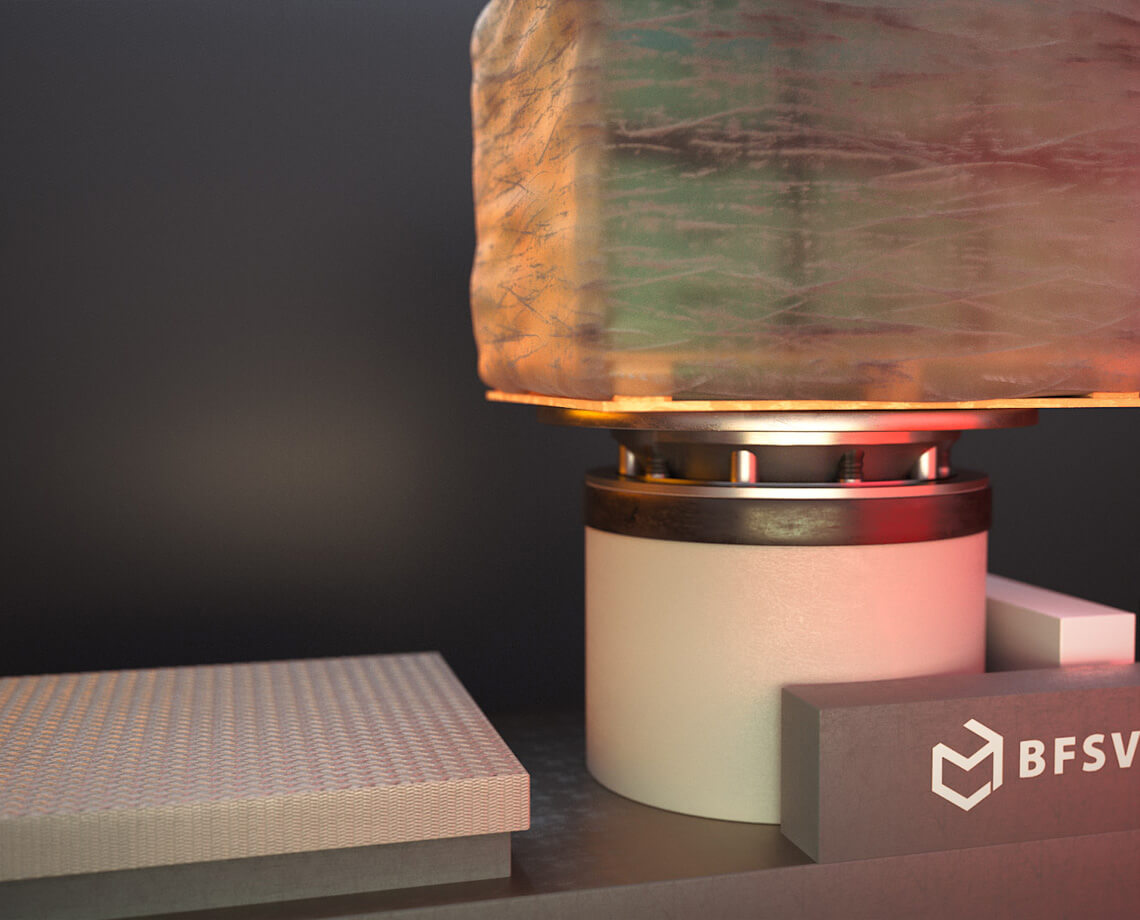
Standards: Vibration testing
- DIN ISO 9022-3: Optics and optical instruments - Environmental test methods, Part 3: Mechanical stress
- DIN EN 60068-2-6: Environmental testing; Part 2: Tests; Test Fc: Vibrations, sinusoidal
- DIN EN 60068-2-64: Environmental tests; Part 2: Test methods; Test Fh: Oscillations, broadband noise (digitally controlled) and guidance
- DIN EN 60255-21-1: Electrical relays; Part 21: Vibration, shock, continuous shock, and earthquake tests; on measuring relays and protective devices; Main section 1: Vibration tests (sinusoidal)
- DIN EN 60512-6-5: Electro-mechanical components for electronic equipment - Methods of measurement and test - Part 6: Dynamic mechanical stress test; Main section 5: Test 6e: Oscillations, noisy
- DIN EN 61373: Railway applications - Equipment of railroad vehicles - Tests for oscillations and shocks
- DIN EN ISO 2247: Packaging - Packages and loading units ready for shipment - Low fixed frequency vibration test
- ASTM D4169-22: Standard Practice for Performance Testing of Shipping Containers and Systems
Your contacts

Karolina Behrens
Dipl.-Ing.
Head of Laboratory for Shipping Simulation

Johanna Lipski
M. Sc.
Deputy Head of Laboratory for Shipping Simulation
Our accreditation & certifications

Accreditation
The German Accreditation Body (DAkkS)
is the national accreditation authority
of the Federal Republic of Germany.

Certification
ISTA certification helps minimise product damage and optimise resource use through effective packaging design.
Recognition
DIN CERTCO certifies and assesses the conformity of products and services on the basis of defined standards.
The competence of our testing laboratories for packaging testing is officially recognised:
We find answers to your questions
We provide expertise, focus on packaging and find answers to your questions - authentically, honestly, competently and without digressing. So that we can answer your questions, test your products and expand your knowledge of packaging, send us your e-mail address and we will get back to you.
We look forward to your individual challenge!

FAQs
What types of vibration testing are available?
We perform sine wave, random (white-noise-like), and shock tests.
What is the difference between sinusoidal and random vibration?
- Sine: A defined frequency sweeps across a range. Used to identify resonances that are particularly problematic or to test for fixed frequencies
- Random: A profile excites many frequencies simultaneously. This realistically simulates transportation, engine vibrations, road irregularities, etc.
Why is vibration testing necessary in the first place?
To test mechanical strength, fatigue behavior, and operational reliability—both during operation (e.g., engines, machinery, electronics) and during transport (trucks, rail, air freight).
Why do we test shocks?
Shock tests simulate impact loads such as shunting impacts in rail transport (horizontal) or shocks caused by stacking containers (vertical).
How is the test sample secured?
It is assembled to resemble the actual product, with modifications as needed. For packaging or pallets, the items are secured in the same way as during transport.
What data is recorded during the test?
Acceleration, any transverse components, shock/peak values, frequency responses, PSD data, and mechanical responses.
How is the documentation carried out?
A test report is typically prepared. The raw data can be provided.