
Blog - Laboratory: Simulating Transport Stresses Using Vibration Testing
Vibration Testing Explained: Simulating Real-World Transportation Stresses in the Laboratory
Whether by road, rail, sea, or air, products and packaging are exposed to a wide range of vibrations and shock loads during transportation. Many of these stresses remain invisible from the outside, yet they can cause damage to packaging, products, or individual components.
Vibrations occur wherever forces act on a system periodically or randomly. A fundamental distinction is made between forced vibrations and self-excited vibrations. Forced vibrations are caused by external influences, such as a vehicle passing over uneven road surfaces or seismic events. Self-excited vibrations, on the other hand, originate within the system itself, for example the flutter of an aircraft wing or the oscillation of a steel cable under a constant airflow.
For manufacturers and shippers, the key question is which loads a product is subjected to during storage and transportation, and whether both the product and its packaging can withstand these stresses.
What Types of Loads Occur During Transportation?
From the manufacturer to the end customer, a shipment passes through numerous transportation and handling processes. During this journey, a wide range of mechanical stresses act on the packaged goods:
- Impacts and shocks during loading and unloading
- Vibrations during transportation by truck, rail, aircraft, or vessel
- Shock loads caused by rough handling
- Resonance effects within products or packaging systems
Depending on the transport route and product characteristics, these stresses can result in abrasion, material fatigue, loosening of components, glass breakage, leakage, or even complete packaging failure. To identify such risks at an early stage, real-world transport loads are reproduced under controlled laboratory conditions.
How Are Vibrations Simulated in the Laboratory?
Different types of vibration exciters are used depending on the application. The following sections introduce three common testing methods: vibration table testing for handling and transport stresses, random vibration testing using servo-hydraulic shakers, and shock testing using electrodynamic shakers.
Vibration Table Testing for Transportation and Handling Stresses
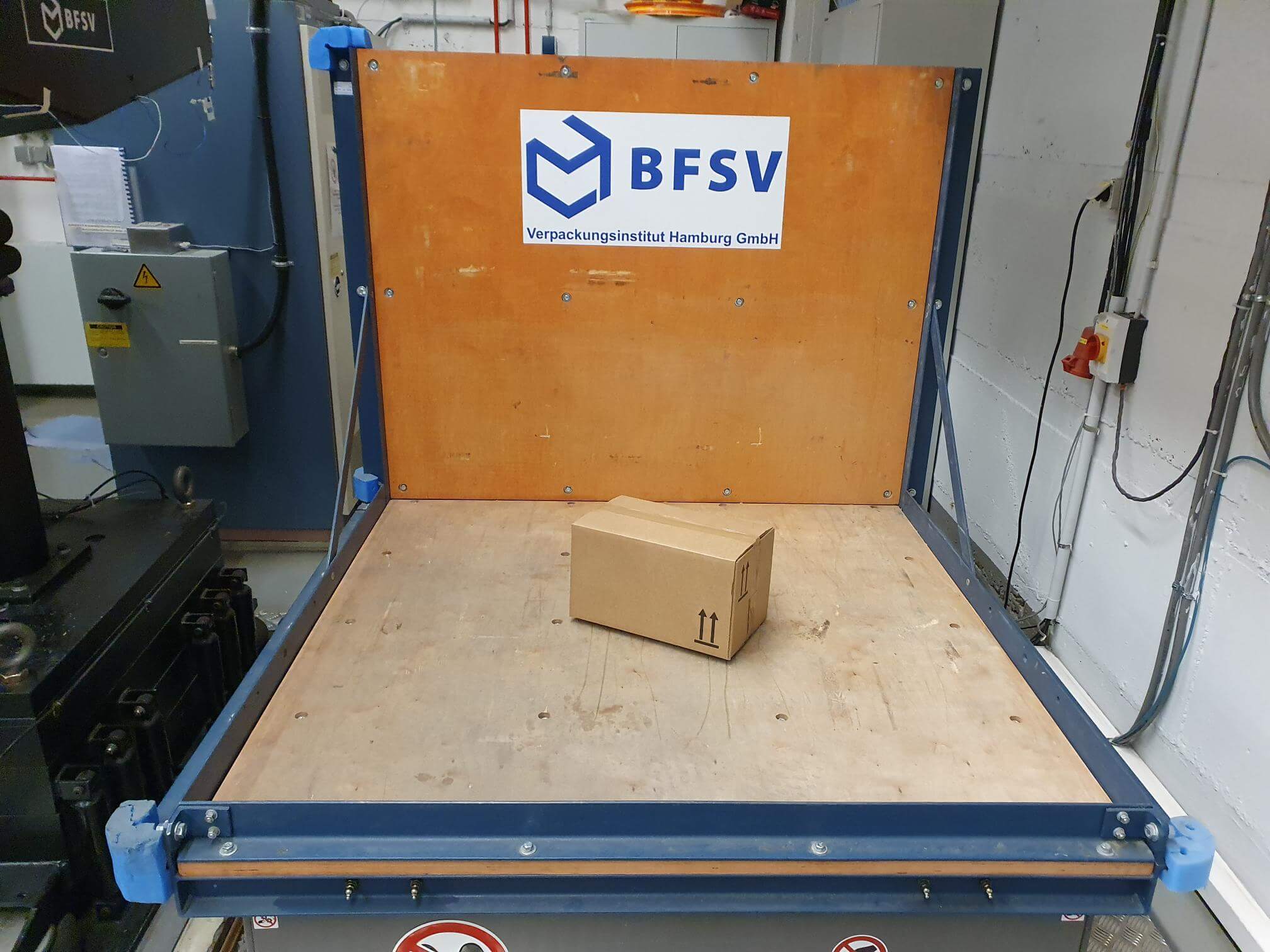
For many packaging tests, an electromechanical vibration exciter, often referred to as a vibration table, is used. The test specimen is subjected to a constant sinusoidal motion. The repeated lifting and impact of the package generate stresses similar to those encountered during transportation.
Typical applications include testing in accordance with ISTA and ASTM procedures, where packages or unit loads are evaluated on all relevant faces and orientations. The objective is to reproduce stresses caused by factors such as poor road conditions or repeated handling operations.
These tests can reveal damage such as abrasion marks, scratches, or deformations. In the case of sensitive products, functional failures or structural breakage may also occur.
Random Vibration Testing for Realistic Transport Simulation
In real-world transportation, vibrations are rarely uniform or predictable. Instead, packaging and products are exposed to complex, random vibration patterns. To reproduce these conditions as realistically as possible, random vibration tests (also known as broadband or noise excitation tests) are performed. These tests simulate the stresses that occur during long-haul transportation by truck, rail, or air.
Such tests can be used to determine:
- Whether products rub against the inside of the packaging
- Whether closures, fasteners, or connections become loose
- Whether packaging materials exhibit premature wear
- Whether sensitive components are damaged during transport
Servo-hydraulic or electrodynamic vibration systems are commonly used to perform these tests, allowing realistic transport conditions to be reproduced under controlled laboratory conditions.


Shock Testing for Severe Mechanical Loads
In addition to continuous vibrations, transportation chains are also subjected to short-duration shock events. These can occur during container handling, pallet placement, or accidental drops during loading and unloading operations.
Electrodynamic shakers are particularly well suited for simulating such loads. They are capable of generating high acceleration levels and rapid velocity changes within extremely short time intervals. This allows a wide range of shock profiles to be reproduced, including half-sine and sawtooth shock pulses.
The effects of these loads can range from loosened connections and broken components to the complete failure of sensitive products. As a result, shock testing is frequently used to verify a product's and package's ability to withstand transportation and operational stresses while maintaining functionality and integrity.


More Than Just Packaging Testing
Vibration testing is not limited to the evaluation of packaging performance. Modern vibration test systems also play a key role in the qualification of products and components. In addition to packaging, electronic assemblies, device components, automotive parts, and industrial products are commonly tested for their resistance to vibration-induced stresses.
Typical applications include:
- Resonance investigations
- Frequency analysis
- Service life and durability testing
- Mechanical load testing
- Qualification of electronic devices and assemblies
- Testing for automotive, rail, aerospace, and marine applications
In particular, electrodynamic shakers offer a wide frequency range, making them suitable for investigating complex vibration-related phenomena and performance requirements.
Which Vibration Systems Does BFSV Use?
| System | Typical Application | Key Features |
|---|---|---|
| Vibration Table | Transport and packaging testing | Simulates repeated lifting and impact events in accordance with packaging test standards |
| Servo-Hydraulic Shaker | Random vibration testing | High payload capacity, large displacement, frequency range starting at approximately 1 Hz |
| Electrodynamic Shaker | Shock, resonance, and durability testing | Breiter Frequenzbereich, verschiedene Signalformen, horizontale und vertikale Prüfungen |
By combining these systems, BFSV can perform both traditional packaging tests and advanced vibration and shock tests for products, assemblies, and technical components.
Would you like to find out how vibrations and shocks affect your packaging?
BFSV supports you in selecting suitable vibration tests and other packaging testing services to evaluate the transport performance and reliability of your packaging solutions.
Your contacts

Karolina Behrens
Dipl.-Ing.
Head of Laboratory for Shipping Simulation

Johanna Lipski
M. Sc.
Deputy Head of Laboratory for Shipping Simulation